
Audio Interface - Low Latency Performance.
Part 2 : Native ASIO Performance on WoA ( Windows on Arm )

This is a continuation of the first Substack article on Audio Interface - Low Latency Performance that I published in May 2024, that can be found Here:
https://dawbench.substack.com/p/audio-interface-low-latency-performance
For those that haven’t read the previous article, it would be worth a read to get the finer detail of the information being presented.
Throughout 2025 I worked extensively on my WoA R&D, which has included testing all the available interfaces that have released native ASIO drivers for the platform, which has been an ongoing process as drivers went through several iterations and updates during the testing phase. Data presented is from drivers that have been through a few cycles and are stabilized.
I am keeping this separate to the main LLP threads and articles as it will just cause confusion with the main Database, as the test sessions are completely different, as is the DAW being used, so no correlation to the ongoing x86 Database which I will continue to maintain.
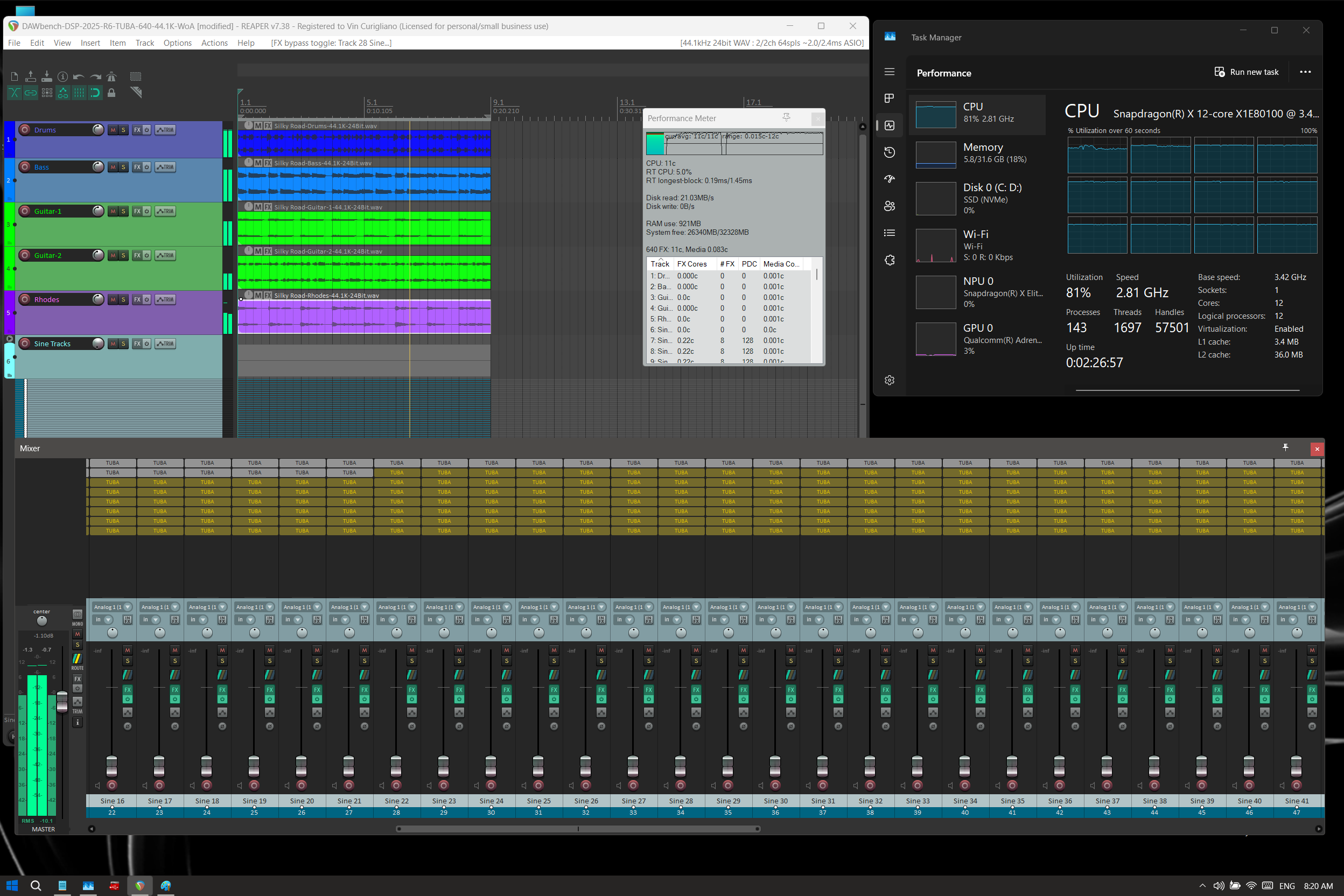
DAWbench 2026 – LLP Test Session Details for WoA.
Reaper is being used as the reference DAW for WoA, DSP plugins are ReaFX RXC INT ( Native) and Analog Obession TUBA (Emulated ). VI test is now being run on KONTAKT 8 Player ( Emulated ) with a different set of samples. Due to some of the elements being run under emulation, I consider this a preliminary Database, which will be amended when all plugins are running natively.
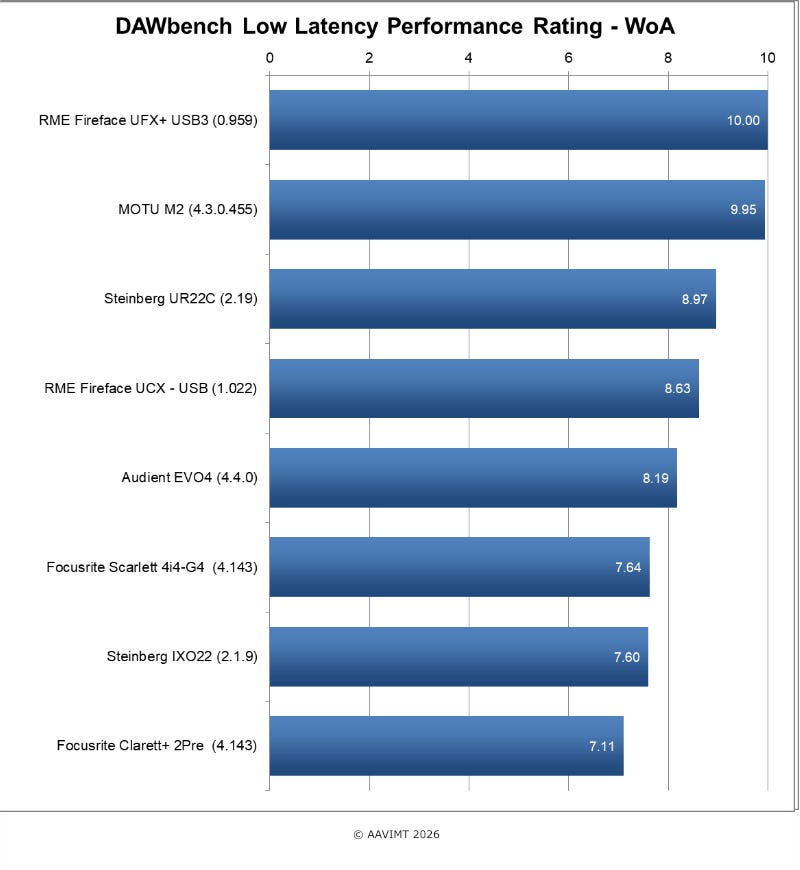
LLP ( Low Latency Performance ) Rating : WoA ( Updated March 2026 )
There is a full explanation on the LLP Rating in the first article, but in summary.
3 reference benchmarks are used - DAWbench DSP – RXC ( INT) and TUBA, and the DAWbench VI benchmark using Kontakt 8P
The results for the DAWbench DSP across the latencies of 032 thru to 256 ( which has been the M.O for the last 14 years ) are added and the total is then % wise gauged against the result for the RME UFX+ baseline interface. The same is then calculated for the DAWbench VI CV/ NCV tests for 032-512.
Those 3 % results are then added and divided by 3 to give an average % .
I thought it important for the I/O and RTL figures to be an influencing factor on the rating as some cards have a lot lower overall latency than others, so the average % results is then multiplied by the last % result for the RTL to give the final LLP Rating.
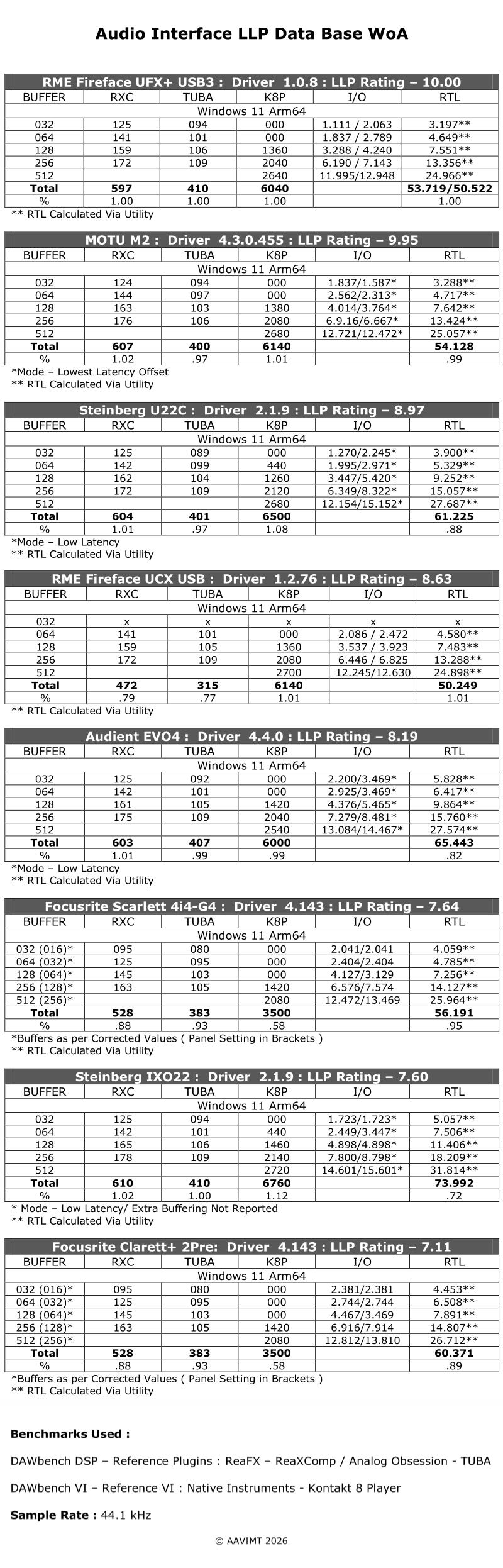
LLP WoA : Getting into the Details ( Updated March 2026 )
An overview on each Interface in order.
RME UFX+ USB3 : This is the LLP Database reference interface despite not being able to run the VI session at 064 , the lower I/O and RTL results elevating it to the top rating.
Performance overall is very solid , the only concern for me atm is the lack of being able to playback cleanly at 064 on the VI test, but until I get KONTAKT running natively, I am not drawing a line under that just yet.
MOTU M2 : This is the latest entry ( March 2026 ) , and MOTU’s first run at a WoA native driver, and to say they have delivered is an understatement. Results close to on par or above in the respective benchmark sessions, with I/O and RTL rivaling the reference RME UFX+ USB3 reference interface. All round great performer.
Steinberg UR22C : This is actually my WoA R&D default reference interface, as it delivers better overall performance across all the buffer settings. The Yamaha driver is the only driver currently managing clean playback at 064 on the VI test.
I/O and RTL is higher than the RME MADIface USB driver used on the UFX+, but delivering great results for a USB interface.
RME UCX USB : This unit uses the original RME USB driver, and as per the UFX+ , I/O and RTL is very close , performance is near identical , but missing the 032 Buffer settings as the original driver only offers a true 048. Performance from 064-512 is near identical to UFX+
Audient EVO4 : There is little to no detail about Audient actually having WoA native drivers, and I was only aware after being directed by Pete Brown to a post from last year on their FB page.
There is zero, and I mean zero, information on their website on the interface product page, spec, driver download page, so I find that a little weird to say the least.
Even more interesting is thats its a Thesycon driver, which means that Thesycon have a native Arm64 driver available for any of their clients using their OEM solutions. The list there is long, but none have released an Arm64 driver apart from Audient, who almost seem to be keeping it a secret?!
All that aside, performance was stable and akin to their upper tier x86 drivers being used by multiple manufacturers that I have tested over the years. I/O and RTL is middle ground, but par for the course for their solutions.
Focusrite Scarlett 4i4 G4 : As has been reported and maintained over the years, Focusrite continue to have their delivered I/O and RTL one setting out from what we would normally expect, which is why I test with the delivered I/O and RTL, and amend the chart to reflect the Panel anomaly, for want of a better word.
Whats interesting in the testing being shifted to Reaper is that the Reaper engine runs on a RT Bloc being reported by the nominal value of the Control Panel , so the actual I/O and RTL are reported and arbitrated correctly re PDC, etc, but the RT bloc processing is one level down from the other interfaces.
Confusing, you bet !
I have been attempting to get Focusrite to address the mismatch of the Panel Settings and I/O and RTL delivered values for years, to no avail, but this is the first time I have actually seen how it can effect overall performance in respective DAW’s.
I originally thought it was more cosmetic and wondered why there was so much resistance to match the Panel Settings to the Delivered values, but have now realized its a lot deeper than that, and that there is some 2x buffering between the bloc buffer and delivered latency buffer.
In short, the reason the VI test has failed at 128 here, is because Reaper is working on the RT Bloc Buffer of 064!
My head hurts.
Steinberg IXO22 : This is another interesting one for me.
I have tested the Yamaha driver across multiple interfaces over the years, results would shift around a bit , sometimes reporting I/O correctly, sometimes misreporting , it was always a bit of a crap shoot to be honest.
I initially bought this interface for the WoA R&D work as it was the one being used at the Snapdragon Summit launch in 2024, and also because Yamaha is developing the Inhouse ASIO driver with MS for W11.
I/O and RTL was not as expected and/or I had hoped. There is a large unreported value in I/O and RTL compared to the UR22C using the same driver, so I can only guess its due to the controller being different. Which will explain the different results with all the other UR interfaces, that being they are not using a consistent controller, like for example RME.
This results in widely varying end results using the exact same driver.
Delivered performance across the benchmarks was actually better than the UR22C, at the expense of a higher I/O and RTL, but then the question of Reapers RT bloc buffer comes into play ?
Focusrite Clarett+ 2Pre : Same driver as the Scarlett, despite having a different installation package/mixer applet.
Slightly higher I/O and RTL over the Scarlett, most likely due to variance in AD/DA , refer to comments on Scarlett for performance, as they are identical.
Conclusion and Final Thoughts.
This is still early days, but its great to see at least 4 manufacturers offering products with native ASIO drivers.
With the Thesycon driver being available for the OEM clients, I am hoping we see more of those manufacturers that have invested in the drivers also release native WoA drivers, but as I was reminded by a close industry friend, they aren’t free, so maybe its a chicken and egg situation there for some.
Be great if Audient actually promoted they have the drivers as well, but I digress !
If you have any further questions on the information in the article, feel free to reach out via socials or email.