
Audio Interface - Low Latency Performance.
Part 3 : The Art of Maintaining and Improving Driver Performance !


Over the course of testing and reporting on audio interface LLP across the last 15+ years, I have at various times navigated driver development from respective manufacturers where updated drivers were not necessarily moving in the right direction. The reasoning’s and extent would vary, and in most cases would be acknowledged if pointed out, and addressed.
In some instances there would be some slight variations and/or hurdles where performance would drop off unexpectedly at various latency over others, or even overall performance would move backwards to varying degree’s. Also, of course, driver development which showed welcome measurable improvements, with varying degrees of everything in between also navigated.
Developing, Maintaining, Improving !
Manufacturers who develop their own Controllers/Firmware and Software/ Drivers inhouse have more easily maintained a consistency over the years across the protocols they have full control of, while others who rely in varying degrees on 3rd party controllers/drivers can at times be navigating dependencies in less than ideal environments.
Many if not most fall into the 2nd category , which I detailed in Part 1 of this series of articles, relying on 3rd party controllers and 3rd party OEM drivers, which can work out O.K, for the most part, but will be harder to address when things go sideways, even severe cases the loss of the 3rd party component. This has happened numerous times over the years, DICE FW controller/driver being one example, and even more recently Audionate discontinued their dedicated Brooklyn II controller chip, which is now licensed for other developers to utilise in their respective FPGA’s. In some instances previous performance has not been maintained.
In short, sometimes updated drivers do not guarantee better performance. Lots of variables from changes in controllers/firmware/driver genealogy, and even available resources and personal can all play a part.
This brings me to the focus of this article, where I will detail revisiting some recently tested interfaces with updated drivers, which I do at various times with my large inhouse interface pool to see if the pins have moved substantially, one way or the other across numerous interfaces.
I’ll highlight 2 well known and established manufacturers interfaces at the extreme ends of the spectrum, one delivering a welcome and measurable performance improvement, the other, well…, read on.
MOTU M2 – Revisted !
Results for original driver v latest !
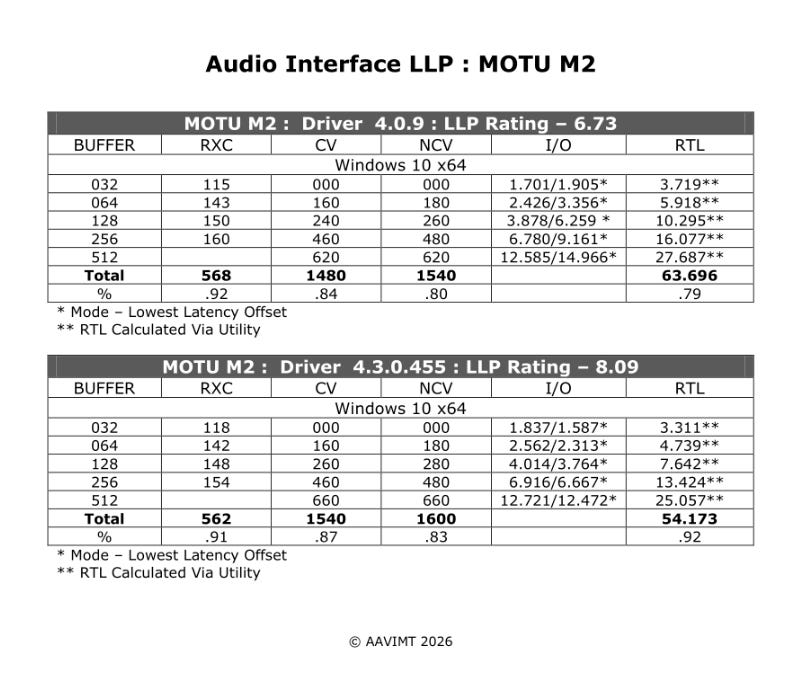
My initial testing for the MOTU M2 driver placed it around mid pack amongst the better USB interfaces tested, and I was pleasantly surprised and initially impressed after having very mixed results with MOTU drivers over previous years, across multiple generational families of interfaces.
The team at MOTU have obviously been putting in some work fine tuning the drivers since my first visit, as the current driver out performs all other USB interface tested except for the RME UFX + USB3 unit, which is impressive to say the least.
MOTU have delivered performance on their USB2 interfaces that is on par with RME !
It also places the unit firmly in the All Time Top 20 , now positioned at 12 .
I haven’t had the opportunity to test their TB/USB4 devices/driver as yet, but if this is anything to go bye, they should be rattling the upper areas of this Database.
Hats off to the team at MOTU , its great to see that there is some focus on improving and delivering true driver performance.
The other interface I decided to have a revisit was the Presonus ( now Fender) Quantum HD2 USB interface, which on my initial testing threw a few curve balls re decisions made to attempt to get RTL’s as low as possible, that would live up to the reputation that they had achieved with the original Quantum TB units.
The above was never going to happen using a Thesycon derived driver, but instead of accepting the workable range the driver/controller offered , ventured into areas that may have looked good on a marketing spread sheet, but proved detrimental to overall driver performance.
The hope was that with the rebranding to Fender and the release of the new Quantum LT’s, that the driver had been amended and repaired.
No such luck :-(
Presonus (Fender) Quantum HD2 - 2026 Revisit !
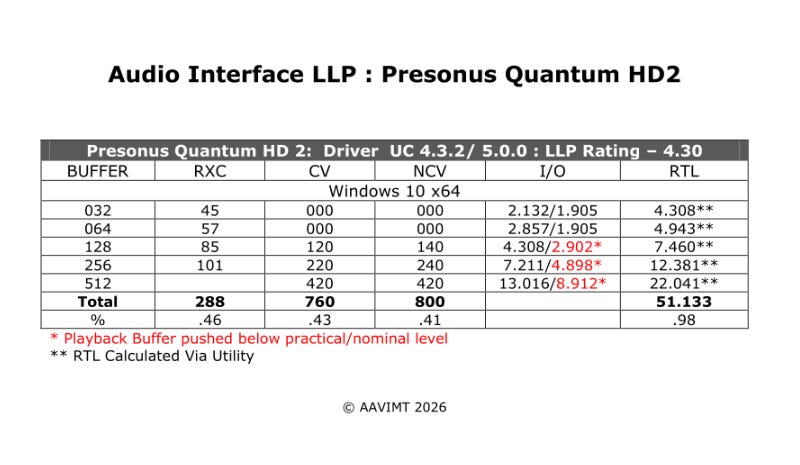
Disappointingly nothing has changed from the original testing run , results are identical for the original V4 and new V5 UC/Driver.
On the original full release driver the decision was made to force the RTL down by pushing the Output Latency below what is practical - 128 being at nominal, 256/512 both being way below nominal, with the subsequent performance collapsing under anything resembling a moderate load.
I had initially forwarded my test findings to Presonus prior to releasing my first report, in the hope that they would acknowledge the issue presented, and resolve the respective latency settings to bring the driver back to within an operational range of the Thesycon driver being used.
My concerns were dismissed, they essentially responded that no one else had complained, that there is nothing to address, the driver is working as designed !
Which brings me to another point, not one so called “reviewer” on the web made a note of the obvious discrepancy between a normal operational range and delivered output latency, and I struggle to believe that they even tested these interfaces under any stress.
I Digress.
Summary and Conclusion !
In short, not all updated drivers perform better, and its not uncommon that driver updates actually degrade performance of interfaces at times. Of course the reasoning for updating drivers and firmware will vary, sometimes required for changes in O.S/Hardware for compatibility, sometimes for technical changes and/or features added to the interfaces, etc.
In an ideal World driver updates and/or new generational hardware/driver changes would/should always maintain and/or improve the overall performance of the interfaces, but the reality at times is not as we would expect.
Some manufacturers and developers get it, some don’t, it is really as simple as that !